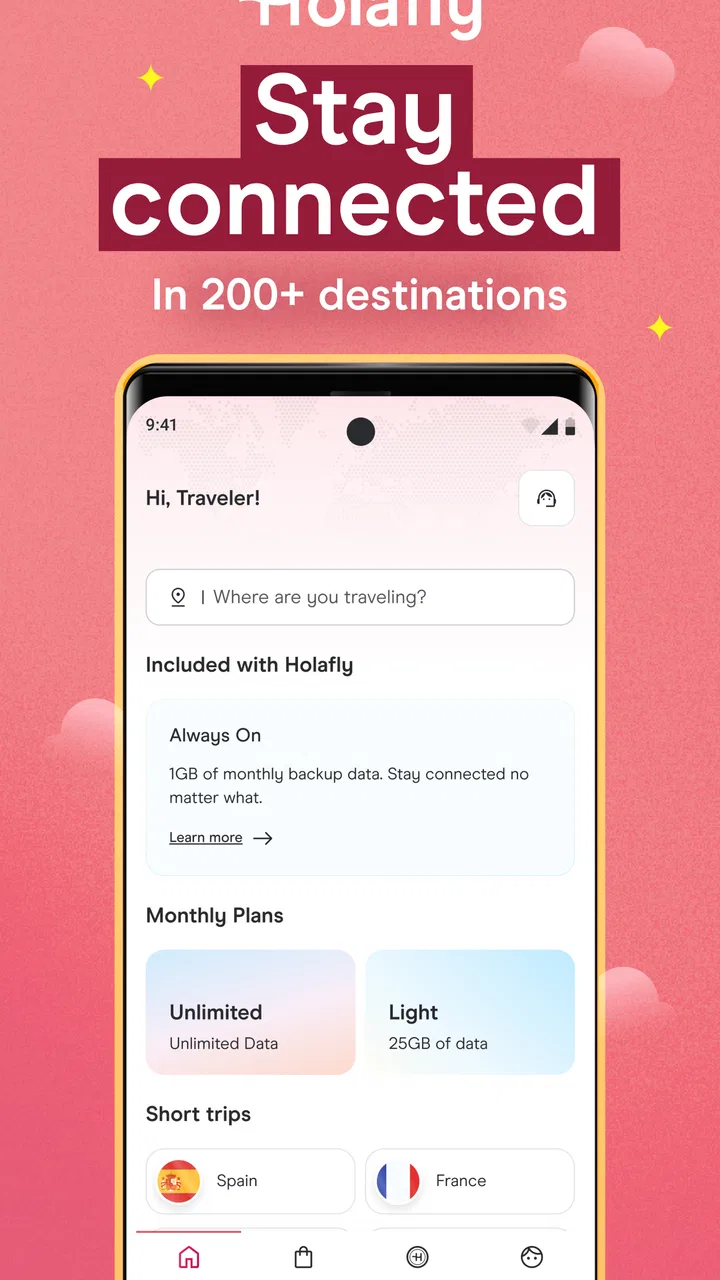
Holafly eSIM: Unlimited Data
- 4.8
- Rating
- 5.00M
- Installs
- Free
- Price

 Analysis by App-foxy
Travel connectivity is one of those problems that feels small until you land somewhere unfamiliar with no reliable internet. I tested Holafly eSIM: Unlimited Data with that situation in mind, looking at more than the first few minutes of setup. The real question is whether it remains useful after the novelty wears off, when the next trip arrives, the phone has accumulated old settings, and you simply want your connection to work without another round of guesswork.
Holafly eSIM: Unlimited Data is a free travel and local app from Holafly: international eSIM. Its job is to help travelers arrange a prepaid eSIM for mobile data instead of buying a physical SIM at an airport or depending entirely on hotel and café Wi-Fi. The app is available to everyone, runs on devices using Android or iOS version 10 and later, and has built a sizable audience, with over a million installs and a 4.6 average from around 47 thousand ratings.
My first impression was that the app makes sense for people who want to solve connectivity before the plane takes off. That sounds obvious, but it changes the whole travel routine. Rather than arriving and immediately searching for a kiosk, comparing unfamiliar plans, or trying to explain your destination to a salesperson, you can prepare the mobile-data side of the trip while you still have a stable connection at home.
You May Also Like

 Blood Strike: 2.5 Anniversary
Blood Strike’s Loadouts Turn Every Drop Into a Tactical Gamble
A close look at Blood Strike’s custom loadouts: how fast access to signature weapons reshapes its battle royale rhythm, rewards preparation, and narrows the gap between fights.

 Pandora - Music & Podcasts
Pandora’s Music Is Easy to Start, but Harder to Recover
Pandora’s strength is its low-effort path from a seed to a station. Its weak spot is how much confidence it asks you to place in connection, setup, and quiet recovery.

 8 Ball Pool
 Is Built on Rivalries, Rematches, and Routine
A close look at the rivalries, rematches, shared routines, and unanswered safety questions that turn a quick pool match into a persistent mobile community.

 Samsung Music
’s Quiet Strength Is Playing What You Already Own
Its reach comes less from spectacle than from dependable access to a personal library. That simplicity is both the app’s strongest retention engine and its ceiling.

 AccuWeather: Weather Radar
AccuWeather Review: A Quick, Clear Forecast for Everyday Decisions
For everyday plans, the best forecast is the one you can understand quickly. AccuWeather makes rain timing, radar, and local conditions easy to act on, with a few trade-offs.

 Hill Climb Racing
Why Hill Climb Racing Still Turns Crashes Into One More Run
A tiny car, a bumpy hill and one more upgrade: Hill Climb Racing keeps resurfacing because its simple chaos makes every near-miss feel personal.
More From Our News Desk



How Holafly eSIM fits into a real travel routine
I find it useful to treat the eSIM as one part of a travel checklist, not a fix for every connection problem. In this section, I’ll look at how the app’s setup and everyday use fit different reading, navigation, and attention needs, then consider what can still make the experience difficult.
The first-week appeal is mostly about removing arrival-day stress
The strongest part of the experience is the preparation workflow. I would use the app before leaving, choose the destination or region relevant to the trip, and complete the purchase and installation process while connected to dependable Wi-Fi. That last detail matters: an eSIM is not something I want to configure for the first time in a crowded airport with a low battery and uncertain public internet.
The practical advantage is not just avoiding a plastic SIM card. It is avoiding the small chain of decisions that follows a physical-SIM purchase: finding a shop, checking whether the plan suits the whole trip, keeping track of the original SIM, and deciding whether to remove it or swap it back later. With an eSIM, the travel line can be prepared alongside the existing line, provided the phone supports eSIM and the device is not restricted in a way that prevents using another carrier.
I would still treat installation as a preparation task rather than an arrival task. Before buying, I would check the phone model, confirm that the device supports eSIM, and make sure the phone is unlocked for another network. These checks are more important than the app interface itself. If the hardware or carrier restriction is wrong, a smooth purchase screen cannot rescue the trip.
Once installed, the useful habit is to label the travel line clearly and keep the normal SIM available for calls or messages if needed. On a dual-line phone, I would select the Holafly line for mobile data and disable data switching so the phone does not quietly fall back to the home line. I would also keep data roaming enabled only where the eSIM instructions require it, then verify the setting before leaving the airport. That small checklist can prevent an unpleasant surprise.
For a realistic example, imagine arriving in Lisbon for a week with a hotel address saved only in an email, a rideshare waiting area to locate, and a need to message family after landing. With a prepared eSIM, I can open maps, check transport information, and send messages immediately instead of hunting for Wi-Fi. The benefit is especially noticeable during the first few hours, when a working connection has value beyond ordinary browsing.
Unlimited data changes how I use the phone while moving around
The appeal of an unlimited-data travel plan is freedom from counting every megabyte. I can use navigation continuously, translate menus, upload a photo, check opening hours, and look up a train platform without treating each action as a budget decision. That is more comfortable than a small prepaid allowance, particularly on trips where plans change throughout the day.
Still, “unlimited” should not be interpreted as a guarantee of identical performance everywhere. The experience depends on the available local network, coverage, congestion, the phone’s radio hardware, and the destination included in the chosen plan. A travel eSIM provides access to mobile data; it does not create signal in a tunnel, remote mountain area, or crowded venue where the local network is struggling.
I also would not assume that unlimited mobile data replaces every other connection. A hotel Wi-Fi network may still be preferable for large operating-system downloads, cloud backups, or moving a large video library. Using the travel line for ordinary travel tasks is one thing; making it the only connection for every heavy transfer is another. The best approach is to use mobile data for mobility and convenience, while saving demanding maintenance jobs for reliable Wi-Fi.
Another useful distinction is between data and a complete phone replacement. The eSIM is most valuable for maps, messaging apps, browsing, translation, booking services, and similar online tasks. If I need my usual phone number for bank verification, voice calls, or text messages, I would keep the primary line active where appropriate and check how my carrier handles roaming. The travel eSIM should be viewed as a connectivity layer, not automatically as a replacement for every service tied to the original number.
Month-to-month value depends on how often I travel
Holafly eSIM: Unlimited Data is easy to appreciate during a trip, but its lasting value is different from that of a daily-use app. I do not open it every morning at home. Its recurring usefulness comes from having a familiar travel-connectivity tool ready whenever another international trip appears.
For frequent travelers, that familiarity can be worthwhile. The app gives me a repeatable process: check compatibility, select the destination, prepare the eSIM, activate it at the appropriate moment, and remove or disable it after returning. Repeating the same workflow is less mentally expensive than starting from scratch with a new airport provider each time.
For someone who takes one short trip every few years, the calculation is less compelling. The app itself is free, but the travel plan is a purchase, so the meaningful cost is tied to each destination and trip rather than to simply installing the application. A person who already has affordable roaming through a home carrier may find that option easier, especially if keeping one number and one billing relationship matters more than having a separate travel plan.
The product is also more attractive for travelers who use a lot of data in unpredictable ways. A person who only checks a map twice a day and spends most of the trip in accommodation may prefer a small local package or included roaming. Someone working remotely, navigating constantly, sharing a connection occasionally, or moving between cities may value the reduced need to monitor usage.
There is a trade-off between simplicity and fine control. A local SIM can sometimes offer a more tailored allowance, a local number, or a lower price for a long stay, but it usually asks me to spend more time comparing options and dealing with local registration or shop visits. Holafly’s approach is better when convenience is part of the purchase. It is less attractive when optimizing every unit of data or obtaining a local telephone number is the main goal.
Maintenance is light, but the important steps happen outside the app
The app does not remove all maintenance; it shifts maintenance into a few phone settings. Before departure, I would make a short checklist: confirm the eSIM is installed, identify the correct line, set it as the data line when abroad, turn off automatic data switching, and keep the primary line configured according to my roaming needs. I would take screenshots of the relevant settings while still at home, because troubleshooting is harder after landing.
After arrival, I would give the phone a moment to register on the local network. If data does not work, the first checks should be the selected data line, roaming status for the travel eSIM, airplane mode, and whether the phone has connected to a supported network. Restarting the device can also be a sensible basic step. These are not glamorous features, but they are the difference between a prepared eSIM and an eSIM that remains installed but unused.
At the end of the trip, I would not delete the travel eSIM immediately if there is any chance I might need information from its setup or want to confirm the primary line is working again. I would switch mobile data back to the normal line, restore the preferred data-switching setting, and then remove the travel eSIM only when I am sure the trip is finished. Deleting the wrong line is a more serious mistake than leaving an old travel profile visible for a little longer.
This is where the app’s maintenance burden becomes clear. Holafly can make the purchase and installation process more approachable, but it cannot make dual-SIM behavior identical across every phone. Android menus vary by manufacturer, and iPhone settings have their own terminology. A user who dislikes changing network settings may find the process stressful, even if the app itself is straightforward.
Where fatigue starts after the first trip
The first trip can make the service feel almost effortless, but repeated use exposes a few sources of friction. The biggest is remembering that an eSIM is a profile inside the phone, not just an order in an app. Buying a plan is only one part of the process; activating the right line and avoiding accidental use of the home line still depends on me.
Another source of fatigue is destination planning. A traveler visiting several countries should read the plan details carefully and make sure the selected coverage matches the complete itinerary. A plan suitable for one country is not automatically the right answer for a neighboring country or an unexpected side trip. This is an area where a local multi-country SIM or a broader regional plan may be more convenient if the route is complicated.
Unlimited data can create its own false sense of security. I might stop thinking about usage, but battery consumption can still rise when navigation, hotspot use, location services, and a bright screen operate together. In practice, I would carry a power bank and download essential maps or reservations for offline access. The eSIM reduces dependence on Wi-Fi; it does not remove the need for basic travel preparation.
Hotspot use deserves particular caution. I would not assume that every unlimited plan treats tethering in the same way or that a laptop session will feel as comfortable as a phone session. Anyone planning to work from a laptop should check the specific plan conditions before relying on it as their office connection. For occasional phone browsing, the service is a clearer fit than for a demanding remote-work setup with large files and video calls.
There is also a psychological limitation: a travel eSIM does not solve every communication problem. If a hotel, airline, bank, or local service insists on sending a code to the original number, I still need access to that line. If I disable it completely, I may miss something important; if I leave it active without understanding roaming behavior, I may create unwanted charges through my home carrier. The safest setup is deliberate rather than automatic.
Who will get the most from it?
I think the best match is a traveler who values a predictable arrival, uses maps and online services throughout the day, and does not want to negotiate with a local carrier after landing. It is also a good fit for people who travel often enough to appreciate a repeatable workflow, but not so often that they already have a carefully optimized local-SIM routine.
It suits short holidays, city breaks, multi-stop sightseeing, and work trips where staying reachable matters. Parents may appreciate having a simple way to keep a phone connected for directions and messaging. A person traveling alone can benefit from being able to access transport information immediately, especially when plans change late at night or after a delayed flight.
I would be more hesitant to recommend it to a long-term visitor who needs a local number, expects to stay in one place for an extended period, or wants the cheapest possible data arrangement. I would also steer away from it for anyone whose phone does not support eSIM or is locked to a carrier. In those cases, a physical local SIM, a carrier roaming package, or a dedicated portable hotspot may be a better answer.
The comparison with ordinary roaming is nuanced. Roaming wins on continuity: one number, familiar settings, and often no separate installation. Holafly wins when roaming prices are inconvenient, when I want to separate travel data from my home plan, or when I prefer to arrange connectivity before departure. The right choice depends less on brand loyalty than on how much I value control, simplicity, and predictable preparation.
What the app’s maturity says about long-term confidence
The application launched in May 2023 and is currently at version 3.18.1, which suggests this is an actively maintained product rather than a one-off utility. I do not treat version numbers as proof that every device-specific issue has disappeared, but continued updates matter for an app connected to changing phone operating systems and travel workflows.
The broad adoption also makes the product feel less experimental. Still, popularity should not replace my own compatibility check. Travel connectivity is unusually sensitive to destination, device, and settings, so a well-known app can still be the wrong choice for a particular phone or itinerary.
I would keep the app installed if I traveled internationally several times a year. Its long-term value would come from reducing preparation time and giving me a familiar place to start, not from daily use. If I rarely travel, I might install it only when planning a trip, complete the purchase and setup, then remove it after returning if I no longer needed it.
My long-term verdict after the convenience wears off
Holafly eSIM earns lasting space for me as a travel tool because it addresses a specific moment exceptionally well: the transition from airplane mode to being independently connected in a new country. The strongest benefit is not unlimited browsing as a slogan; it is the practical freedom to use maps, messages, translation, and transport services without searching for a shop or relying on the first Wi-Fi network I find.
Its weaknesses are equally practical. I still need a compatible, unlocked phone, careful dual-SIM settings, a backup plan for weak coverage, and awareness that data access is not the same as a local phone number. Those requirements are manageable, but they mean the app is not completely hands-off.
My recommendation is simple: use it when arrival-day reliability and setup convenience matter more than squeezing out the lowest possible data cost. I would prepare it at home, save essential travel information offline, keep the primary line under control, and treat the eSIM as a focused travel connection rather than a universal replacement for my mobile service.
For that audience, the app has value beyond its first-week novelty. It becomes a small, repeatable part of trip preparation—useful precisely because I do not need to think about it every day. For infrequent travelers, heavy local-number users, or people with locked devices, another option may be better. But for compatible phones and data-hungry trips, Holafly’s approach is convenient enough to remain in my travel toolkit.
FAQs for Holafly eSIM: Unlimited Data
01What is Holafly eSIM and how does it work?
Holafly eSIM is a digital SIM card that provides unlimited data for your smartphone without the need for a physical SIM card. Once purchased, you can instantly download the eSIM profile onto your phone, enabling you to access mobile data services in various countries without swapping out your existing SIM.
02Can I use Holafly eSIM on any device?
Holafly eSIM is compatible with most modern smartphones that support eSIM technology. Before purchasing, check if your device supports eSIM by going to the settings menu or consulting your device's manufacturer. iPhones from the XS model onwards, as well as several Android devices, typically support eSIM.
03How do I install and activate Holafly eSIM?
After purchasing Holafly eSIM, you will receive a QR code via email. Scan this code using your phone's camera or the settings menu to install the eSIM profile. Follow the on-screen instructions to activate the eSIM for use, ensuring you have a stable internet connection during the process.
04What countries are covered by Holafly eSIM?
Holafly eSIM offers coverage in multiple countries worldwide, including the United States, European nations, Asia, and more. However, coverage may vary based on the specific plan you purchase. Always check the Holafly website for the latest list of supported countries and regions before buying.
05Is Holafly eSIM truly unlimited, and are there any hidden fees?
Holafly eSIM provides unlimited data without throttling or hidden charges, ensuring consistent internet access during your travels. However, it's important to review the terms of service to understand any fair usage policies, which may vary depending on the region and specific data plan you select.
Pros
- Unlimited data plans available.
- Easy to set up and activate.
- Supports multiple countries.
- No hidden roaming fees.
- 24/7 customer support.
Cons
- Limited eSIM compatibility.
- Can be costly for short trips.
- No voice call support.
- Possible connectivity issues in remote areas.
- No option for data rollover.

Holafly eSIM: Unlimited Data
Gallery